
Michael’s Greenhouses

Poinsettias
At Michael’s Greenhouses in Cheshire, Connecticut, pest monitoring is becoming more efficient and easier to act on. During the 2025 poinsettia season, the team started using Trap-Eye™ to gain better insight into whitefly and thrips pressure across the crop. The goal was clear: reduce repetitive sticky card work, improve visibility, and support more targeted biological control decisions.
Earlier insight, less manual work
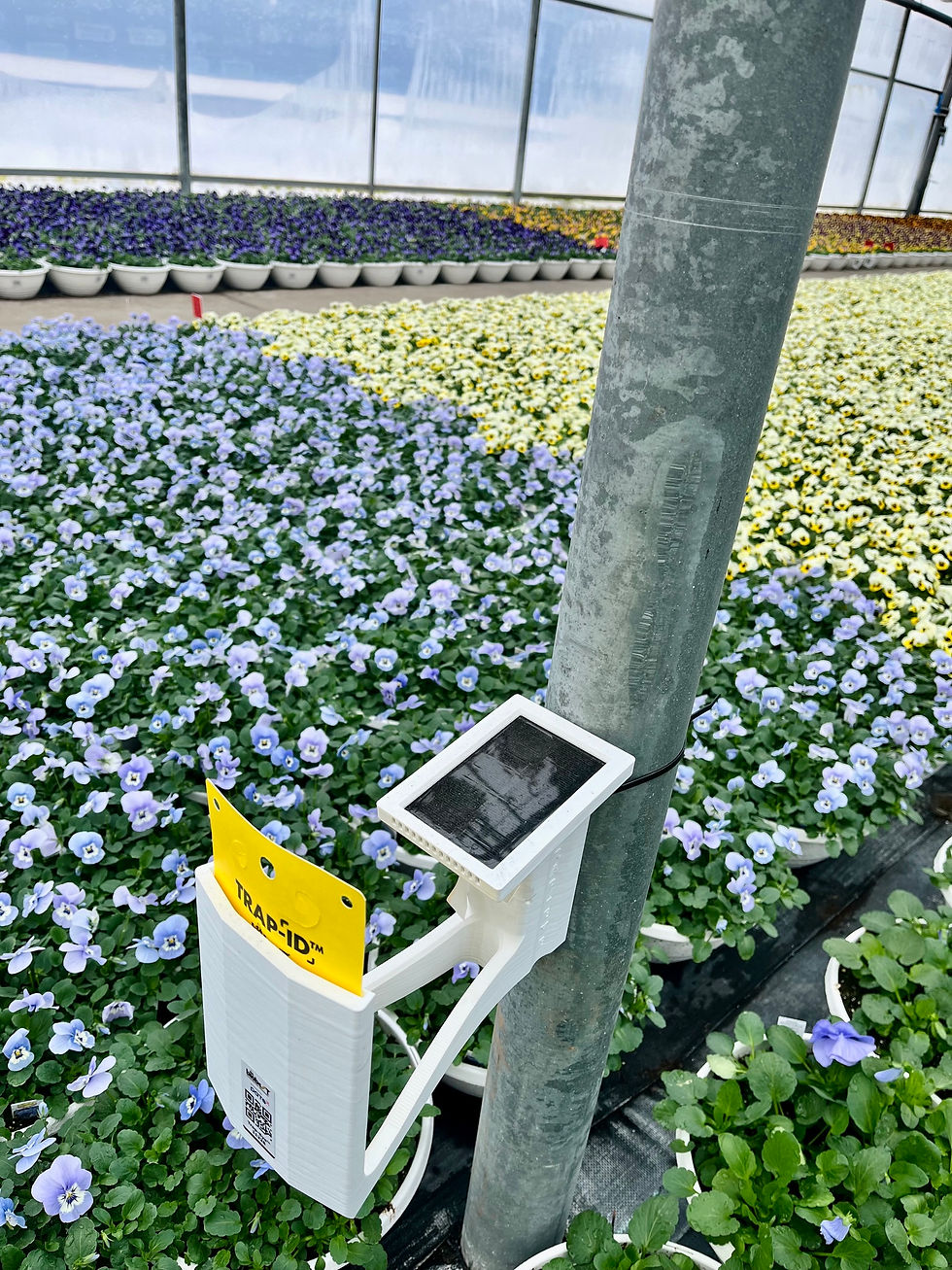
Sticky card scouting is an important part of IPM, but it can be time-consuming and depends on regular manual checks. With Trap-Eye™, sticky cards are photographed automatically, and AI software identifies and counts insects from the images.
At Michael’s Greenhouses, Trap-Eye™ was placed across several greenhouse sections during poinsettia production. This gave the team a clearer view of where pest pressure was developing, supported by dashboard tools such as heatmaps and threshold alerts.
Instead of waiting for routine scouting moments, the team could follow pest development more continuously and respond before pressure built up further.

Supporting biological control
Michael’s Greenhouses uses biological control throughout poinsettia production and aims to avoid unnecessary spraying where possible. With Trap-Eye™, the team could see where whitefly pressure was increasing and focus their response more precisely.
As Head Grower Laurie Conlon explains:
“Trap-Eye helped us pinpoint exactly where whitefly populations were increasing, allowing us to apply biological control in a higher concentration where it was most needed. This improved the efficiency of the same biological control strategy.”
During the monitored trial, the poinsettia crop in those areas did not require insecticide applications. Trap-Eye™ also reduced the repetitive work around sticky card checks, with cards being replaced less often while pest pressure remained visible throughout the crop.
Practical AI in the greenhouse
For Michael’s Greenhouses, Trap-Eye™ showed how AI can support daily greenhouse decisions in a practical way. The system does not replace grower experience, but adds a clearer and more consistent layer of information to support scouting and IPM.
A year after the original trial, Michael’s Greenhouses still uses Trap-Eye™ and remains satisfied with the system. With better visibility, remote image access, and more targeted biological control, the team continues to use automated monitoring as part of its pest management strategy.
For growers, this is where AI becomes useful in practice: not as a buzzword, but as a tool that helps reduce guesswork, save time, and act with more confidence.
Want the full story on Michael’s Greenhouses journey with PATS?
Read the Greenhouse Grower feature


